2023: The Year Menstrual Products are Tested with Blood for the First Time
“Because menstruation is so shrouded in shame and secrecy, we don’t socialize people to be curious about it as a bodily process. It’s presented as a problem to solve,” says Chris Bobel, an associate professor of women’s, gender, and sexuality studies at the University of Massachusetts Boston.
Yes, you read that right - on August 7th, 2023, the absorbency of menstrual products were tested with real blood for the first time. Ever. The study was led by four women at Oregon Health & Science University - Dr. Emma DeLoughery, Dr. Alyssa C. Colwill, Dr. Alison Edelman, and Dr. Bethany Samuelson Bannow - testing the absorbency of the menstrual cup, menstrual disc, tampon, menstrual pad, and period underwear. They were given permission to use expired human blood from OHSU that could no longer be used in a clinical setting, making it the first time in history that these products were tested using blood.
Almost every menstrual product is organized by its absorbency rate on grocery shelves - whether it’s for a light flow, heavy flow, etc - so what have companies been using to test the absorbency rate? Saline! As a puberty educator and the village period lady (so to speak), this information is incredibly unsettling to me. Saline is absorbed extremely different from blood, not to mention that there is typically more than just blood that is released during a period (i.e. tissue, etc). Since the number of menstrual products a person goes through each cycle has been the way doctors consider how healthy a person’s cycle is, this information is concerning. This means that we really don’t know how much blood we’re losing during our periods, which in turn means that we can’t have an accurate perspective on how healthy our cycles really are. Are we losing more blood than we think we are, or are we losing far too little?
This is precisely why these researchers decided to lead this study. By publishing, they are allowing doctors to better gauge if someone is experiencing heavy menstrual bleeding and other symptoms that can effect their physical, emotional, and social quality of life. By using real blood, they are prioritizing women’s health and the health of other people who menstruate - demographics that have for too long not been prioritized in medicine.
This is a huge win for menstrual and cyclical health - and also a shock to everything we though we knew about our cycles and the products we’ve been using since we started bleeding.
I invite you to read A Brief History of Modern Menstrual Products below with your adolescent so that you can have a powerful conversation together about the products you’re using and how your youth wants to care for their changing body. The results from the OHSU study using real blood is below this next section - which I of course encourage you to read as well.
A Brief History of Modern Menstrual Products
The commercialized menstrual products we see on the shelves today have been around since 1888, when Johnson & Johnson released disposable menstrual pads called “Lister’s Towels.” Kotex came after in 1919, inspired by the wood pulp bandages that nurses found in hospitals and used as menstrual pads. These wood pulp bandages were normally used to bandage wounds, making them highly absorbent and presumably just as effective for menstrual blood flow. This same material is what Kotex used when they first released their own disposable pads in 1919!
Unlike the pads we know today, they did not yet have a sticky underside - they were held close to the body by the belted sanitary napkin, like the Hoosier Belt. Tampons, on the other hand, were first invented in 1929 by inspiration of the vaginal sponge some women used during menstruation.
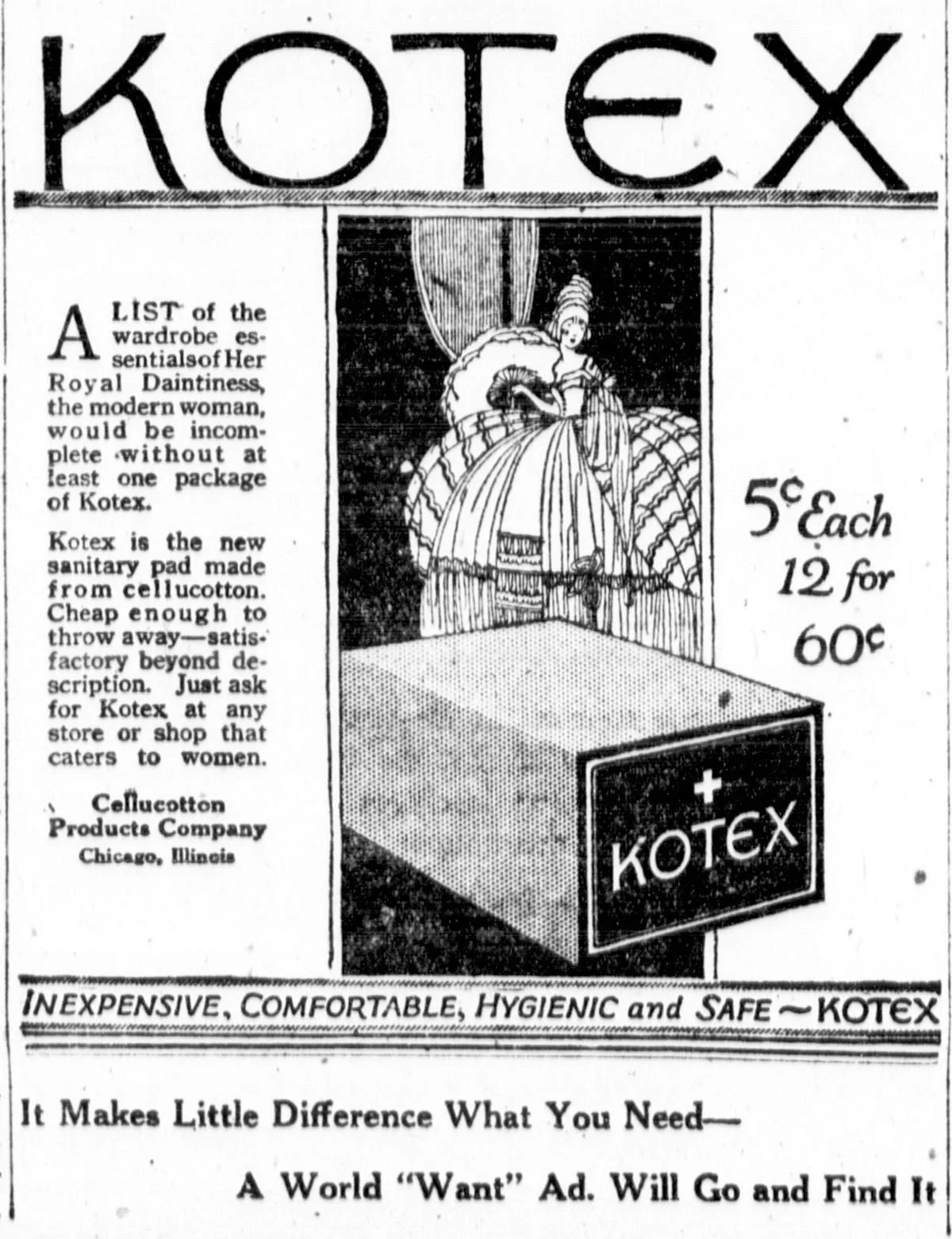
Stigma is no stranger to the history of menstrual products. It was common for there to be a lot of embarrassment when women asked for sanitary napkins in a store - particularly when there was a male store clerk. Talking about menstruation in publicly was largely taboo - and unfortunately, it sometimes still is today! In response to these uncomfortable interactions, Kotex rebranded to encourage women in advertisements to ask for “Kotex” rather than “sanitary napkins.” This small shift in language created more comfort when people needed to purchase more menstrual products at the store.
Around the time of the release of the modern tampon, the in-store interactions changed. In order for women to purchase menstrual products, they had to secretly place money in a box in the store rather than buying them in front of the store clerk. It’s fascinating how much meaning and stigma culture places on completely normal biological processes. Imagine how difficult it must have been for a woman to see a doctor for menstrual abnormalities - would she even know something was wrong if they couldn’t talk about it in public?
By the 1980s, the belted sanitary napkin was almost entirely replaced by new pads with sticky undersides that could attach directly to a person’s underwear. There are new menstrual products that have come out since then - like the menstrual cup (originally created in 1867, resurged in 1987, and only recently became popular) or period underwear (released in the past decade). However, this doesn’t mean that everyone has access to menstrual products.
I encourage you and your youth to watch the documentary “Period. End of Sentence.” on Netflix. This is a great documentary about the lack of access to menstrual products in rural India, where women rely on homemade sanitary cloths or nothing at all in a culture where periods are wrapped in shame. The inability for women to talk about menstruation correlates directly with their health and hygiene, and the documentary does a wonderful job of showcasing how open conversation and access to care can revolutionize the way we care for our bodies.
What Using Real Blood Has Revealed About Our Menstrual Products
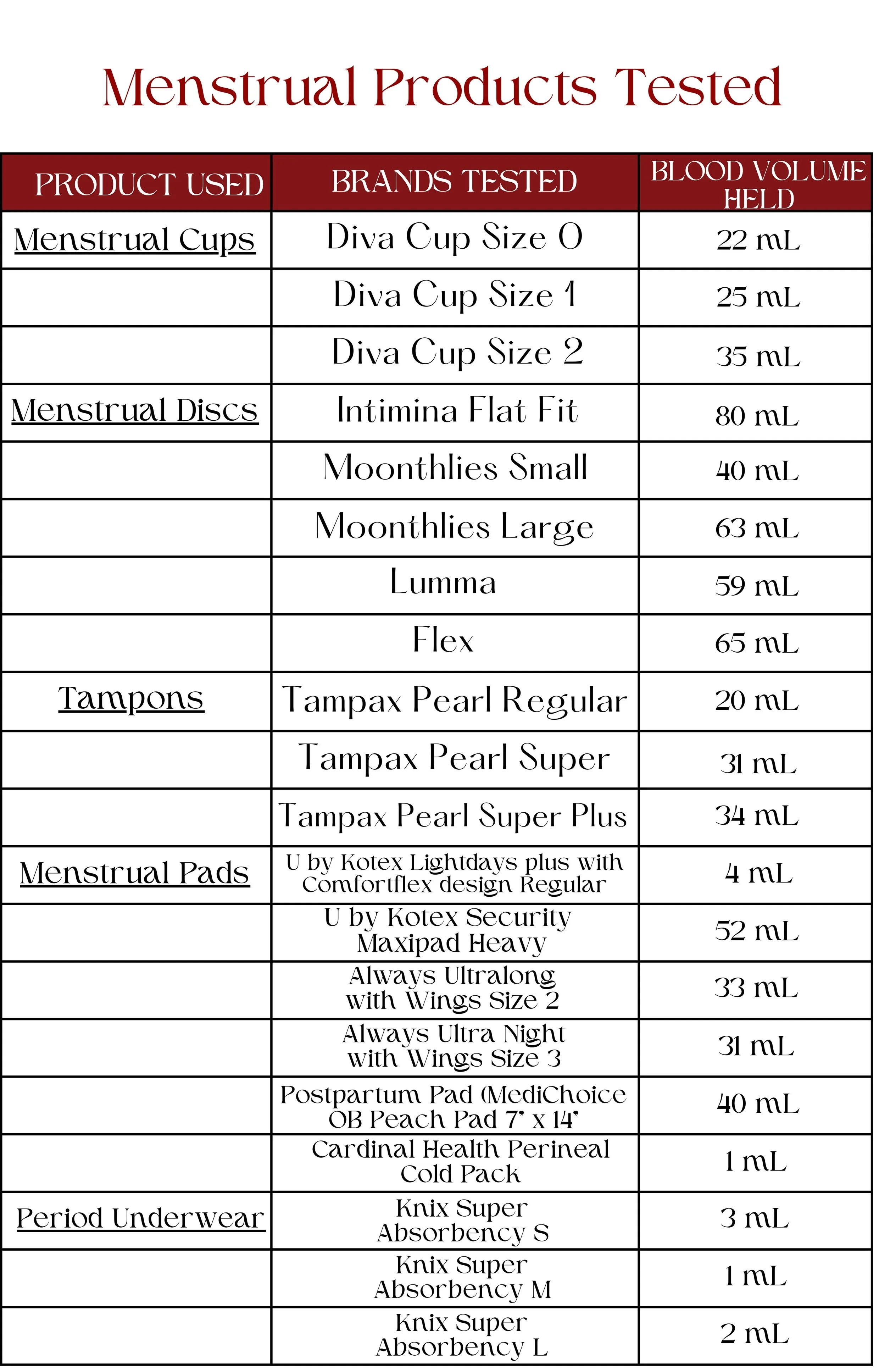
Here are the key findings of the OHSU study that are important for you to know as you move forward in purchasing menstrual products:
The majority of all tested products advertise that they absorb much more than this study discovered they actually do. The researchers believe this is due to using saline rather than real blood.
Menstrual discs held the most blood while period underwear held the least. This is not to say one is better than the other - choose your products based on comfort and need!
While period underwear is advertised to hold many tampons worth of blood, it really only absorbs a small amount of blood and does so very slowly. This isn’t the ideal method for those with a heavy flow or blood clots, and it is recommended by this study to use as a backup method.
Tampons, pads, and menstrual cups hold similar amounts of blood, respectively. Absorbency is only one factor to consider when choosing your menstrual products. Comfort, functionality, body type, and other factors are just as important. Choose the products that feel right for you!
Absorbency isn’t the main factor when choosing menstrual products - however, it is extremely relevant when talking about the heaviness of your periods, which can be helpful in addressing hormonal imbalances, disorders, and more. More than 80 mL of blood is considered an abnormally heavy flow, and is cause to seek care. With the findings from this study, this means that three full Always Ultralong with Wings Size 2 pads signal an abnormally heavy flow. Boy, does that change the way we see how many products we go through each cycle!
The Bottom Line: When we normalize biological processes like menstruation and free our conversations of it from shame, we are also putting our health in the forefront and advocating for our bodies’ normal, natural processes.